


AGEM
Willkommen bei der Arbeitsgemeinschaft Ethnologie und Medizin (AGEM)
Die AGEM ist ein 1970 gegründeter gemeinnütziger Verein mit dem Ziel, die Zusammenarbeit zwischen der Medizin, den angrenzenden Naturwissenschaften und den Kultur‑, Geistes- und Sozialwissenschaften zu fördern und dadurch das Studium des interdisziplinären Arbeitsfelds Ethnologie und Medizin zu intensivieren.
Was wir tun
- Herausgabe der Zeitschrift Curare
- Durchführung von Tagungen
- Dokumentation von Literatur und Informationen
Curare
Zeitschrift für Medizinethnologie
aktuelle Ausgabe | Archiv aller Ausgaben | Call for Papers
Veranstaltungen
Anja Dreschke & Michaela Schäuble: SANTU PAULU MEU FALLA GUARIRE
Ausstellung
Installation im Rahmen der Austellung „return” im Rautenstrauch-Joest-Museum, Köln
SANTU PAULU MEU FALLA GUARIRE
2‑Kanal-Videoinstallation, 2024, 14 Min.
von Anja Dreschke & Michaela Schäuble

Ausstellung RETURN | 17.09. – 6.12.2026
Rautenstrauch-Joest-Museum Köln – Kulturen der Welt
Cäcilienstraße 29–33
50667 Köln
Santu Paulu wird im apulischen Dialekt der Heilige Paulus genannt. Er ist der Schutzpatron all derer, die von Gifttieren wie Spinnen, Skorpionen und Schlangen gebissen wurden.Im süditalienischen katholischen Volksglauben wird der Heilige in Liedern angefleht, diejenigen zu heilen, die sich «wie von der Tarantel gestochen» gebärdeten. Der süditalienische Tarantismus ist ein kulturelles Phänomen, das von Medizinern im Mittelalter auch als ›Tanzwut‹ oder ›Choreomanie‹ bezeichnet wurde. Betroffen waren zumeist Frauen, deren Anfälle und Ekstasen auf den Biss einer Giftspinne zurückgeführt wurden. Heilung versprach die Pizzica (von pizzicare, jmd. zwicken), ein ursprünglich therapeutischer Tarantella-Tanz, bei der die Betroffenen auf bestimmte Melodien, Rhythmen, aber auch auf Farben reagierten und oft tagelang bis zur kompletten Erschöpfung tanzen mussten. Im 17. Jahrhundert, als die Erforschung des Phänomens einen Höhepunkt erreichte, wurde der Tarantismus gemeinhin als chorea imaginative („imaginativer Tanz”) oder chorea lasciva („spielerischer Tanz”) bezeichnet und aufgrund seiner Nähe zu dionysischen Kulten mit Hexerei in Verbindung gebracht. Bereits in den frühesten Quellen wurde die Tarantella als Tanz der Begeisterten und Besessenen beschrieben und als emotionaler, verkörperter Ausdruck von Erregungs- und Ekstasezuständen (Manie) gesehen. Seit den 1950er Jahren gibt es zahlreiche Film‑, Foto- und Tonaufnahmen des Phänomens. Heute wird der Tarantismus, der die Betroffenen einst stigmatisierte, umgedeutet und öffentlich aufgeführt. Pizzica-Musik und Tarantella-Tänze sind als Teil der lokalen Folklore Apuliens zu einer wichtigen kulturellen und ökonomischen Ressource geworden: als Touristenspektakel, als immaterielles Kulturerbe und nicht zuletzt als Strategie zur Bewältigung individueller und kollektiver Krisen. Die Installation basiert auf der mehrjährigen künstlerisch-ethnografischen Feldforschung von Anja Dreschke und Michaela Schäuble, die auf den Spuren des Tarantismus Süditalien bereist und in Archiven recherchiert haben. Sie ist Teil des kollaborativen Forschungsprojektes TARANTISM REVISITED.
Mehr Infos zu der Ausstellung: https://r‑e-t-u-r‑n.net/en
Public Health After the Pandemic: Unpacking (Bio-)Moralities
Call for Papers
International Workshop, Vienna
CfP for the workshop “Public Health After the Pandemic: Unpacking (Bio-)Moralities”
April 1–2, 2027
Health Matters Research Group | Medical Anthropology & Global Health
Department of Social and Cultural Anthropology
University of Vienna
The call for abstracts is open until November 30, 2026. Submit your abstracts, and feel free to circulate the call!
Approximately five years after the declared end of the COVID-19 pandemic, this international workshop opens a space to reflect on the (bio-)moralities sustaining public health. The pandemic changed public health and how we engage with it, leaving traces that did not disappear with the end of the emergency declaration. We invite contributions that engage with the assumptions, valuations, and justifications through which public health problems and their target populations are defined, imagined, and governed, and that explore whose lives and which forms of life public health comes to care for.
We welcome contributions unpacking public health moralities along three interrelated axes:
- Temporalities — how public health moralities shape which pasts are remembered, which lives are cared for in the present, and which futures are imagined and prepared for.
- Geographies — how public health moralities sustain or contest unequal valuations of lives across local, regional, national, global, and planetary scales.
- Technologies and Infrastructures — how public health moralities are materialized in technologies and infrastructures.
We welcome contributions from anthropology, science and technology studies, political science, public health ethics, global health, and adjacent fields, engaging empirically, conceptually, or methodologically with these themes.
Submission: Abstracts of up to 250 words and a short biography (up to 100 words), by November 30, 2026, to biomoralities@kl.ac.at. Notifications by December 15, 2026.
Accepted participants will circulate an extended abstract (1,500–3,000 words) by March 12, 2027.
Read the extended call in the attachment and stay up to date on the workshop: https://www.kl.ac.at/en/university/faculties/department-biomedical-and-public-health-ethics/projects/testing-biogovernance
Organized by the „Testing (Bio-)Governance” project (Austrian Science Fund/FWF): Mara Köhler, Paul Just, Ingrid Metzler (KLU Krems); Erik Aarden, Jana Kunschitz, Victoria Meklin (University of Klagenfurt); Keerthi Dubbala, Julia Aschauer-Gegner (Dept. of Biomedical Ethics and Public Health Ethics, KLU Krems); Katharina T. Paul (Political Science, University of Vienna).
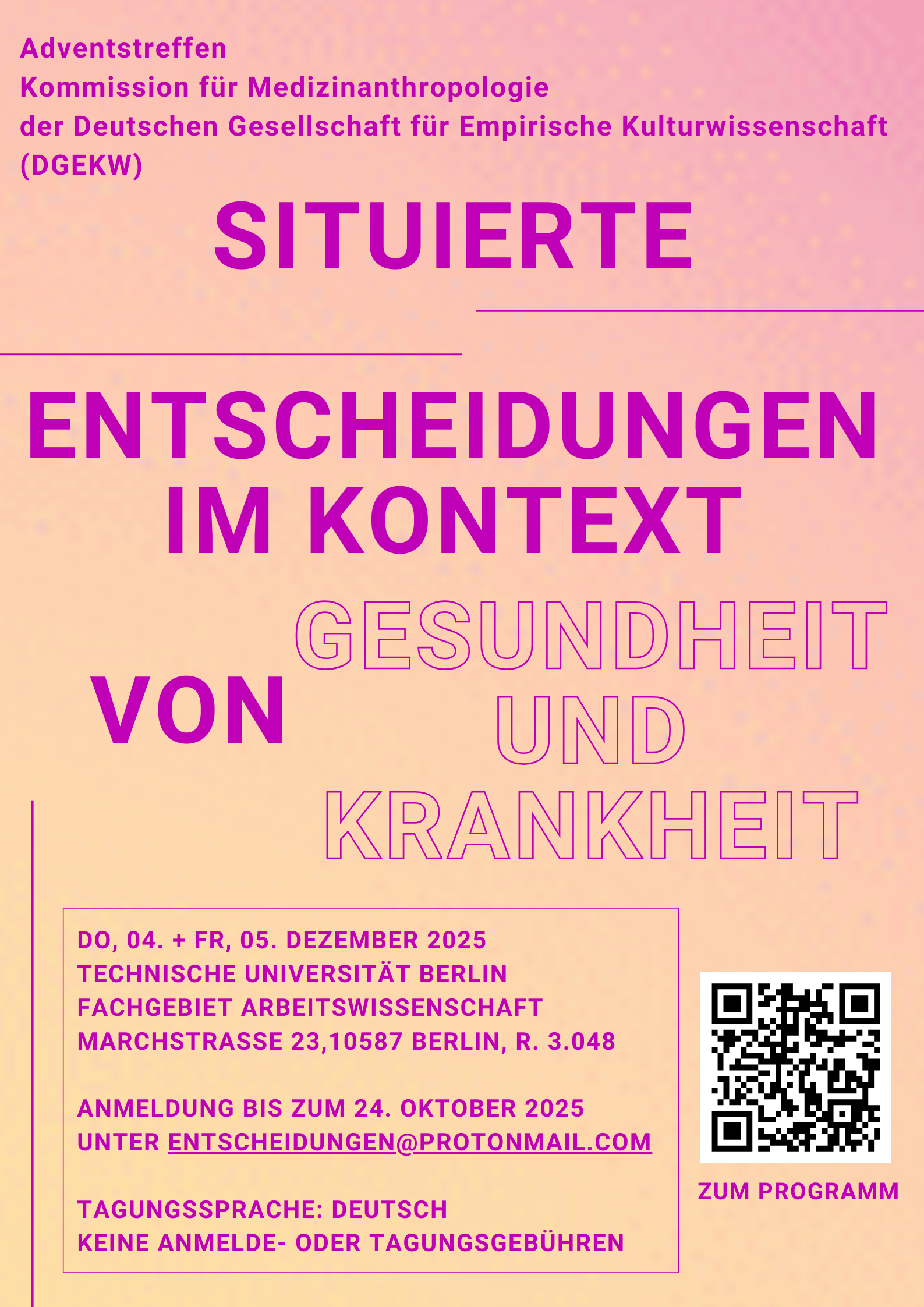
Situierte Entscheidungen im Kontext von Gesundheit und Krankheit
Workshop
Einladung der Kommission für Medizinanthropologie der DGEKW
Einladung zum Adventstreffen „Situierte Entscheidungen im Kontext von Gesundheit und Krankheit”
Kommission für Medizinanthropologie der DGEKW
Do, 04. und Fr, 05. Dezember 2025
Technische Universität Berlin
Marchstraße 23, Raum 3.048
Im Fokus stehen medizinische Entscheidungen, wie sie im Zusammenspiel mit sozialen, kulturellen, politischen und technologischen Bedingungen entstehen – oft überraschend, widersprüchlich oder kreativ. Die Beiträge loten das Verhältnis aus – theoretisch, empirisch, konzeptionell und methodisch. Das ausführliche Programm finden Sie unten
Während des Adventstreffen ist auch ein Kommissionstreffen geplant. Die Veranstaltung findet ausschließlich in Präsenz statt. Tagungssprache ist Deutsch. Es werden keine Anmelde- oder Tagungsgebühren erhoben. Sollten Sie darüber hinaus an einer Vernetzung interessiert sein oder im Journal-Club der Kommission mitwirken wollen, der sich an verschiedenen Terminen im Semester trifft, melden Sie sich gerne bei uns.Bei Interesse melden Sie sich bitte bis zum 24. Oktober 2025 an unter entscheidungen@protonmail.com.