
Anja Dreschke & Michaela Schäuble: SANTU PAULU MEU FALLA GUARIRE
Ausstellung
Installation im Rahmen der Austellung „return” im Rautenstrauch-Joest-Museum, Köln
SANTU PAULU MEU FALLA GUARIRE
2‑Kanal-Videoinstallation, 2024, 14 Min.
von Anja Dreschke & Michaela Schäuble

Ausstellung RETURN | 17.09. – 6.12.2026
Rautenstrauch-Joest-Museum Köln – Kulturen der Welt
Cäcilienstraße 29–33
50667 Köln
Santu Paulu wird im apulischen Dialekt der Heilige Paulus genannt. Er ist der Schutzpatron all derer, die von Gifttieren wie Spinnen, Skorpionen und Schlangen gebissen wurden.Im süditalienischen katholischen Volksglauben wird der Heilige in Liedern angefleht, diejenigen zu heilen, die sich «wie von der Tarantel gestochen» gebärdeten. Der süditalienische Tarantismus ist ein kulturelles Phänomen, das von Medizinern im Mittelalter auch als ›Tanzwut‹ oder ›Choreomanie‹ bezeichnet wurde. Betroffen waren zumeist Frauen, deren Anfälle und Ekstasen auf den Biss einer Giftspinne zurückgeführt wurden. Heilung versprach die Pizzica (von pizzicare, jmd. zwicken), ein ursprünglich therapeutischer Tarantella-Tanz, bei der die Betroffenen auf bestimmte Melodien, Rhythmen, aber auch auf Farben reagierten und oft tagelang bis zur kompletten Erschöpfung tanzen mussten. Im 17. Jahrhundert, als die Erforschung des Phänomens einen Höhepunkt erreichte, wurde der Tarantismus gemeinhin als chorea imaginative („imaginativer Tanz”) oder chorea lasciva („spielerischer Tanz”) bezeichnet und aufgrund seiner Nähe zu dionysischen Kulten mit Hexerei in Verbindung gebracht. Bereits in den frühesten Quellen wurde die Tarantella als Tanz der Begeisterten und Besessenen beschrieben und als emotionaler, verkörperter Ausdruck von Erregungs- und Ekstasezuständen (Manie) gesehen. Seit den 1950er Jahren gibt es zahlreiche Film‑, Foto- und Tonaufnahmen des Phänomens. Heute wird der Tarantismus, der die Betroffenen einst stigmatisierte, umgedeutet und öffentlich aufgeführt. Pizzica-Musik und Tarantella-Tänze sind als Teil der lokalen Folklore Apuliens zu einer wichtigen kulturellen und ökonomischen Ressource geworden: als Touristenspektakel, als immaterielles Kulturerbe und nicht zuletzt als Strategie zur Bewältigung individueller und kollektiver Krisen. Die Installation basiert auf der mehrjährigen künstlerisch-ethnografischen Feldforschung von Anja Dreschke und Michaela Schäuble, die auf den Spuren des Tarantismus Süditalien bereist und in Archiven recherchiert haben. Sie ist Teil des kollaborativen Forschungsprojektes TARANTISM REVISITED.
Mehr Infos zu der Ausstellung: https://r‑e-t-u-r‑n.net/en
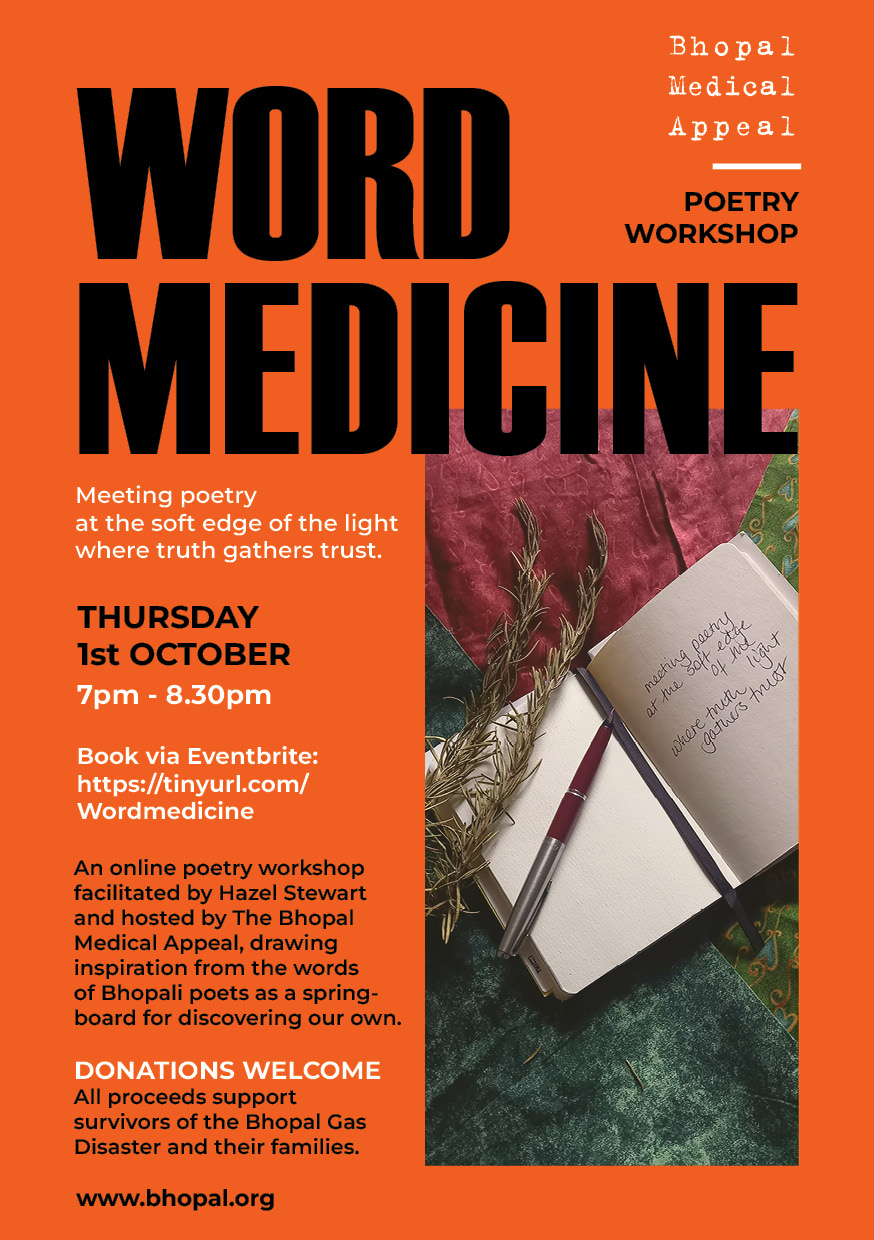
Word Medicine
Workshop
Online Workshop
Online Poetry Workshop: „Word Medicine”
October, 7–8.30pm (UK time)
Online via Zoom
Cost: By donation — all proceeds support survivors of the Bhopal Gas Disaster and their families
On the night of 2–3 December 1984, a Union Carbide pesticide factory in Bhopal, India, released methyl isocyanate and other toxic substances into densely populated neighbourhoods surrounding the plant. More than half a million people were exposed, and thousands died in the immediate aftermath. The consequences of the disaster, however, have extended across generations, with continuing health, environmental, social and political effects for survivors, their families and communities in Bhopal.
The Bhopal Medical Appeal is currently exploring the potential of poetry and creative writing as forms through which the history and continuing legacy of the disaster might be narrated, remembered and collectively engaged with. In June 2026, we began this exploration with Unprecedented Negligence: Collective and Individual Responses to the Bhopal Disaster, an online poetry workshop facilitated by poet and writer Hazel Stewart. We are now pleased to invite you to Word Medicine, the second workshop in this series.
Facilitated by Hazel, the 90-minute workshop marks the 30th anniversary of the Sambhavna Trust Clinic, which has provided community-based healthcare to survivors and their families for three decades. Drawing on poems by Bhopali poets and others, Hazel will use poetry as a starting point for finding our own words. Through creative writing exercises and wordplay, we will explore healing, love, hope and care, while reflecting on the forms of creativity, resilience and collective care that have emerged in Bhopal over the past four decades, alongside the continuing struggle for justice.
No previous writing experience is required. Whether you regularly write poetry or have never taken part in a creative writing workshop, you are warmly invited to join us.
Book your place via Eventbrite:
https://www.eventbrite.co.uk/e/word-medicine-poetry-workshop-tickets-2000962426482
We invite you to join us as we continue to explore what poetry can make possible in remembering, responding to, and telling the story of Bhopal.
Humanitarian Reset: Technopolitics and the Infrastructures of Aid
Konferenz
Invitation for open panel at 2026 4S Conference, Toronto, Canada
Invitation for open panel „ ‚Humanitarian Reset,’ Technopolitics and the Infrastructures of Aid”
2026 4S Conference
Toronto, Canada
October 7–10, 2026
Deadline for submission: April 30, 2026
4S Open Panel #111
Organizers:
Roda Siad, McGill University
Alphoncina Lyamuya, University of Southern California
Abstract:
In 2025, the UN’s Office for the Coordination of Humanitarian Affairs called for a ‘humanitarian reset’ amid proliferating crises, rising displacement, and shrinking donor funding. Framed as a radical reform moment, the ‘reset’ has emerged as a dominant term for grappling with profound sector-wide institutional stress. Initiatives such as UN80 and the ‘reset’ are positioned as opportunities to reimagine how aid is organized and delivered by streamlining coordination, embracing anticipatory action, prioritizing assistance, devolving authority to local actors, and mobilizing digital technologies and private sector partnerships to do “more with less.” Yet these reforms are not merely neutral or technical. They represent a reconfiguration of power within humanitarian systems, enacted through the reset as a techno-political project.
We invite scholars and practitioners working at the intersection of humanitarianism and science and technology studies to examine the reset, its promises, underlying assumptions, and how it is shaped by, and productive of, technopower. We ask: how are aid infrastructures, including data governance systems, cash delivery platforms, forecasting tools, prioritized aid mechanisms, and accountability frameworks, being redesigned under conditions of austerity and urgency? What sociotechnical imaginaries shape reforms proposed under the reset, and how are they entangled with ideas of efficiency, expertise, innovation, market logics, and new forms of public-private authority? How do calls to “shift power closer to communities” intersect with expanding technological mediation and data-intensive systems that may simultaneously enable and undermine local agency?
This panel foregrounds the reset as an ongoing, contested process rather than a settled reform agenda. Contributions may engage empirically, theoretically, or conceptually with topics including localization and accountability, anticipatory action and early warning systems, protection issues, humanitarian-corporate collaboration, activism, and advocacy under shrinking humanitarian footprints. We welcome submissions exploring tensions between efficiency and care, innovation and justice, decentralization and responsibility-shifting, and technocratic expertise and lived experiences.
Submission guidelines and additional panel details (panel #111) can be found here.
Remaking Responsibility: Environmental Harm, Care, and Accountability
Konferenz
Young Scholars’ Conference at the Humanities Centre for Advanced Studies „Futures of Sustainability”, Universität Hamburg
Co-designing school-based mental health interventions for young people and their families: learning from global evidence
Workshop
NHS Ayrshire & Arran Social Sciences & Humanities Research Webinar
„Co-designing school-based mental health interventions for young people and their families: learning from global evidence”
Guest speaker: Dr Fiona Samuels, Wolfson Institute of Population Health, Queen Mary University of London
Date: Monday 12 October 2026
Time: 1.00 pm
Format: Online
Register here: https://events.teams.microsoft.com/event/7493d1b5-9311–4c10-b47e-bc08ccd2d9b3@10efe0bd-a030-4bca-809c-b5e6745e499a
Evidence suggests that school-based mental health programmes can be effective in promoting positive mental health and wellbeing among young people. This webinar will explore how co-designed and co-created approaches, involving young people, families and communities, can improve the relevance, uptake, effectiveness and sustainability of interventions.
Drawing on research in Tanzania, Vietnam, Cambodia and the UK, Fiona will share key findings, lessons learned and future opportunities to support youth mental health.
About our guest speaker: Dr Fiona Samuels is Reader in Global Health and Inequalities and Co-Lead of the Global Public Health Unit at the Wolfson Institute of Population Health, Queen Mary University of London. An anthropologist with more than two decades of experience working at the research-policy interface, Fiona’s work focuses on mental health and psychosocial wellbeing, gender-based violence, maternal and reproductive health, and health systems strengthening. She is particularly interested in co-design, participatory approaches and the social determinants of health and wellbeing.
The Social Sciences & Humanities Webinar Series provides an opportunity for staff, students and partners to hear from leading researchers working across a broad range of disciplines and topics relevant to health, wellbeing and care.
Public Health After the Pandemic: Unpacking (Bio-)Moralities
Call for Papers
International Workshop, Vienna
CfP for the workshop “Public Health After the Pandemic: Unpacking (Bio-)Moralities”
April 1–2, 2027
Health Matters Research Group | Medical Anthropology & Global Health
Department of Social and Cultural Anthropology
University of Vienna
The call for abstracts is open until November 30, 2026. Submit your abstracts, and feel free to circulate the call!
Approximately five years after the declared end of the COVID-19 pandemic, this international workshop opens a space to reflect on the (bio-)moralities sustaining public health. The pandemic changed public health and how we engage with it, leaving traces that did not disappear with the end of the emergency declaration. We invite contributions that engage with the assumptions, valuations, and justifications through which public health problems and their target populations are defined, imagined, and governed, and that explore whose lives and which forms of life public health comes to care for.
We welcome contributions unpacking public health moralities along three interrelated axes:
- Temporalities — how public health moralities shape which pasts are remembered, which lives are cared for in the present, and which futures are imagined and prepared for.
- Geographies — how public health moralities sustain or contest unequal valuations of lives across local, regional, national, global, and planetary scales.
- Technologies and Infrastructures — how public health moralities are materialized in technologies and infrastructures.
We welcome contributions from anthropology, science and technology studies, political science, public health ethics, global health, and adjacent fields, engaging empirically, conceptually, or methodologically with these themes.
Submission: Abstracts of up to 250 words and a short biography (up to 100 words), by November 30, 2026, to biomoralities@kl.ac.at. Notifications by December 15, 2026.
Accepted participants will circulate an extended abstract (1,500–3,000 words) by March 12, 2027.
Read the extended call in the attachment and stay up to date on the workshop: https://www.kl.ac.at/en/university/faculties/department-biomedical-and-public-health-ethics/projects/testing-biogovernance
Organized by the „Testing (Bio-)Governance” project (Austrian Science Fund/FWF): Mara Köhler, Paul Just, Ingrid Metzler (KLU Krems); Erik Aarden, Jana Kunschitz, Victoria Meklin (University of Klagenfurt); Keerthi Dubbala, Julia Aschauer-Gegner (Dept. of Biomedical Ethics and Public Health Ethics, KLU Krems); Katharina T. Paul (Political Science, University of Vienna).
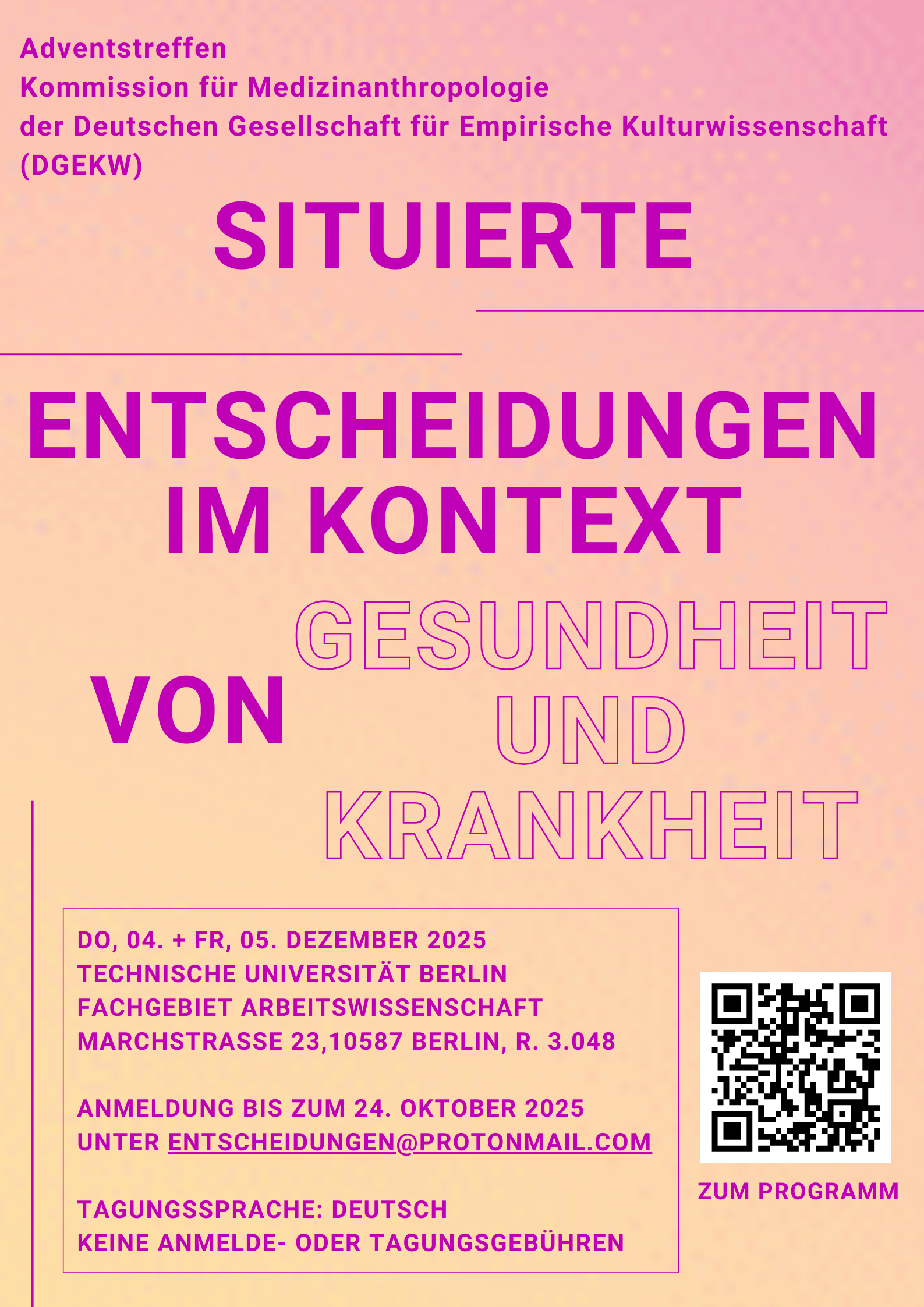
Situierte Entscheidungen im Kontext von Gesundheit und Krankheit
Workshop
Einladung der Kommission für Medizinanthropologie der DGEKW
Einladung zum Adventstreffen „Situierte Entscheidungen im Kontext von Gesundheit und Krankheit”
Kommission für Medizinanthropologie der DGEKW
Do, 04. und Fr, 05. Dezember 2025
Technische Universität Berlin
Marchstraße 23, Raum 3.048
Im Fokus stehen medizinische Entscheidungen, wie sie im Zusammenspiel mit sozialen, kulturellen, politischen und technologischen Bedingungen entstehen – oft überraschend, widersprüchlich oder kreativ. Die Beiträge loten das Verhältnis aus – theoretisch, empirisch, konzeptionell und methodisch. Das ausführliche Programm finden Sie unten
Während des Adventstreffen ist auch ein Kommissionstreffen geplant. Die Veranstaltung findet ausschließlich in Präsenz statt. Tagungssprache ist Deutsch. Es werden keine Anmelde- oder Tagungsgebühren erhoben. Sollten Sie darüber hinaus an einer Vernetzung interessiert sein oder im Journal-Club der Kommission mitwirken wollen, der sich an verschiedenen Terminen im Semester trifft, melden Sie sich gerne bei uns.Bei Interesse melden Sie sich bitte bis zum 24. Oktober 2025 an unter entscheidungen@protonmail.com.
CfP: VANDA Roundtable: Untying social suffering. Witnessing and reparation in the context of chronicity
AGEM-Veranstaltung
Roundtable in the frameworks VANDA Conference
Roundtable „Untying social suffering: witnessing and reparation in the context of chronicity”
VANDA Conference
16 to 19 February 2027
University of Vienna
We are pleased to invite you to submit an abstract for our roundtable „Untying social suffering: witnessing and reparation in the context of chronicity” at the VANDA Conference, taking place from 16 to 19 February 2027 at the University of Vienna. You can submit your paper here until 12 October 2026. The roundtable is conceived as a space for collective discussion, and contributions do not need to take the form of a finished paper or fully developed argument. The idea is to bring different research interests and experiences into dialogue, and explore connections, tensions and questions across our work. We hope to use the roundtable format to think together through questions that may still be open, unsettled or taking shape.
Organizers: Beatriz Aragón Martín, Daniela Jacob Pinto, Lucia Mair. Discussant: Miriam Tickin
Abstract: Social suffering is created in many ways by the functioning of societies we live in. This suffering may be bodily, psychological, moral and relational, often ongoing, and not the result of spectacular events of violence. Rather, it is embedded in the ways in which daily life is reproduced, in the worlds of work, in how care is given or withdrawn. In this sense, social suffering is unequally distributed through society, with certain subjects and groups being more exposed to social suffering, harm and premature death than others. This roundtable intends to develop on this issue from the perspectives of witnessing and reparation. Indeed, medical practitioners and anthropologists are also the witnesses of the suffering of their patients and interlocutors: pain is not only an individual human experience but a demand for its recognition (Das, 2007), and this moral relationship is pervasive in medical practice as well as the practice of medical anthropology. In this context, we seek to reflect on what it means to bear witness to the suffering of others (personally but also for the discipline): what does it take to become a “witnessing professional” (Lipton 2026)? What forms of reparation can be sought through the practice of bearing witness? What does it mean to repair in the context of structural violence? What forms of recognition are possible within this context?
Epidemiological Surveillance in the Global South
Workshop
Workshop in Manchester
„Epidemiological Surveillance in the Global South”
22–23 February 2027
Manchester
Deadline for abstract submissions is 30 September 2026
While epidemiological surveillance is understood as a medico-technical or bureaucratic response to diseases occurrences and/or epidemic situations, it is also a historically situated, materially grounded, and socially embedded practice. Scholarship in the history of medicine, science and technology studies and medical anthropology has shown that surveillance activities emerge within particular political, epistemic and institutional contexts, revealing how diseases and populations are made visible and governable (Foucault 1977; Armstrong 1995; Bashford 2006; Weir and Mykhalovskiy 2010; Fearnley 2010; Barney 2014; Engelmann 2020).
Adopting such a perspective brings to the fore the fragile and often invisible epistemic, material and human infrastructures that undergird and enable surveillance (Keck and Lakoff 2013; Reubi and Cochrane 2025). These infrastructures include laboratories and diagnostic tests, medical categories and classification manuals, paper or digital reporting forms and records as well as social survey methodologies and mapping strategies. They also encompass scientific and expert networks, knowledge about diseases, environments, populations and cultures as well as philanthropic, commercial and state funding streams. Most importantly perhaps, they include the people who carry out surveillance – doctors in hospitals, technicians in the lab, data collectors at sentinel sites, entomologists in the field, activists in the community – with their concerns, interests and beliefs (Shapin 1989; Geissler and Molyneux 2011; Biruk 2018; Keck 2020).
These infrastructures help make up the world in which we live (Hacking 2002; Law 2009; Boellstorff 2011; Lowray 2017; Reubi 2020). They bring about not just new kinds of people and societies but also new sorts of epidemics and diseases as well as pathological ecologies and environments. Surveillance infrastructures and their world-making powers are embedded in and shaped by scientific, political and commercial projects, whose beliefs, interests and hierarchies they, in turn, help support and reinforce. The medico-topographical surveys used by European military doctors during the nineteenth century colonization of Asia and Africa are a good illustration (Arnold 1993; Moussy 2015; Koch 2017). As tools for knowing the tropical lands of jungles and fevers opened through military conquest, these surveys were key to ruling and exploiting the colonies, consolidating a fascination with physical geography and the relationship between climate, race, and health. Similarly, mid-twentieth century colonial tropical medicine experts and entomologists deployed ecological inspections and laboratory analyses to map the associations between climate, soil, plants, pathogens, animals and humans that, they believed, explained epidemics like yellow fever and malaria (Anderson 2004; Weibel 2015; Cummisky 2020). Likewise, late twentieth century talk of a growing cancer epidemic in the global South based on data collection at sentinel sites and mathematical forecast modeling has been increasingly mobilised by postcolonies building national healthcare systems and transnational pharmaceutical companies in search of new markets (Vaughan 2018; Fraser et al. forthcoming).
We warmly invite anyone interested in contributing to discussions on the history and social study of epidemiological surveillance in the global south. We are interested in papers that engage with some of the following questions:
1. How do different logics of epidemiological surveillance, including military, policing, and caring rationalities, coexist, overlap, or come into tension across historical contexts?
2. What human, material, ecological, political, and epistemic infrastructures underpin epidemiological surveillance, and how are these infrastructures assembled, maintained, and transformed?
3. How have projects of empire, postcolonial nation‑building, and commercial interests shaped the development, organisation, and deployment of epidemiological surveillance?
4. What scientific and political languages, narratives, and forms of knowledge production structure epidemiological surveillance practices and render diseases, epidemics, human and animal populations and ecologies legible?
5. What material infrastructures and technologies, such as transport systems, laboratory equipment, digital platforms, satellite technologies, and paper or electronic reporting tools, are required for epidemiological surveillance to function?
6. What human communities, expert cultures, and scientific networks are central to the operation and circulation of epidemiological surveillance systems?
7. Who are the often-invisible technicians, intermediaries, and forms of labour that sustain epidemiological surveillance infrastructures, and how is their work organised and valued?
8. What are the temporal afterlives of epidemiological surveillance infrastructures, including their persistence, decay, reuse, or transformation into new forms and practices?
9. What does epidemiological surveillance produce, beyond the detection of disease itself?
The workshop will be the occasion to identify standout contributions for a forthcoming Special Issue on epidemiological surveillance in the global south, to be published in a leading journal. The workshop will be held in person, with limited hybrid access. It will take place over two days, starting at lunchtime on Monday 22 February and finishing late afternoon on Tuesday 23 February 2027, at the Centre for the History of Science, Technology and Medicine, University of Manchester. Lunch, coffee/tea and dinner will be provided. Limited funds for travel and accommodation will be available if needed.
The deadline for abstract submissions is 30 September 2026. Please send a 250-word abstract and author bio to Adedamola Adetiba (adedamola.adetiba@manchester.ac.uk), Thandeka Cochrane (thandeka.cochrane@anthro.ox.ac.uk) and David Reubi (david.reubi@kcl.ac.uk). For further information, please contact Adedamola Adetiba, Thandeka Cochrane or David Reubi at the email addresses above.
CfP Ageing Multiple: Navigating Relational and Social Lives of Ageing, Caring and Dying
Panel
Event in the frameworks of ISA World Congress of Sociology 2027 in Gwangju, Korea
CfP for a panel: Ageing Multiple: Navigating Relational and Social Lives of Ageing, Caring and Dying at ISA World Congress of Sociology 2027 in Gwangju, Korea 4–10 July.
This session—listed under both RC11 Sociology of Aging and RC15 Sociology of Health —sits at the intersection of ageing, caring, and dying. We invite cutting-edge cross-disciplinary scholarship to couple ageing with processes of caring, dying, and endings to consider it to be fundamentally social, relational, and multiple. Topics might include but are not limited to:
– How epistemic/conceptual tensions emerge when ageing, caring, and dying intersect;
– How institutional and structural expectations and (gendered, classed, racial, and other) ideals about ageing, caring, dying, and loss are formed, sustained, and challenged;
– How emotion and affect play a role in understanding, experiencing, and supporting ageing, caring, and dying, and;
– How existing and emerging intersections of ageing, caring, and dying transform everyday lives, infrastructures, institutions, and (imagined/collective) futures.
Abstract could be submitted by visiting ISA World Congress of Sociology Abstract submission portal: https://isaconf.confex.com/isaconf/wc2027/cfp.cgi. Any questions please don’t hesitate to reach out.